Commercial doors must provide security during normal operations while allowing people to exit quickly during an emergency. This balance is especially important at schools, healthcare facilities, churches, municipal buildings, offices, industrial properties, and other facilities with employees, visitors, students, patients, or members of the public.
Properly selected and installed panic hardware for commercial buildings can support emergency egress, building security, accessibility, and dependable daily operation. Seven Oaks Commercial Doors and Hardware helps organizations evaluate, repair, retrofit, and replace commercial doors and hardware throughout North Carolina, South Carolina, and South Central Virginia.
What Is Panic Hardware?
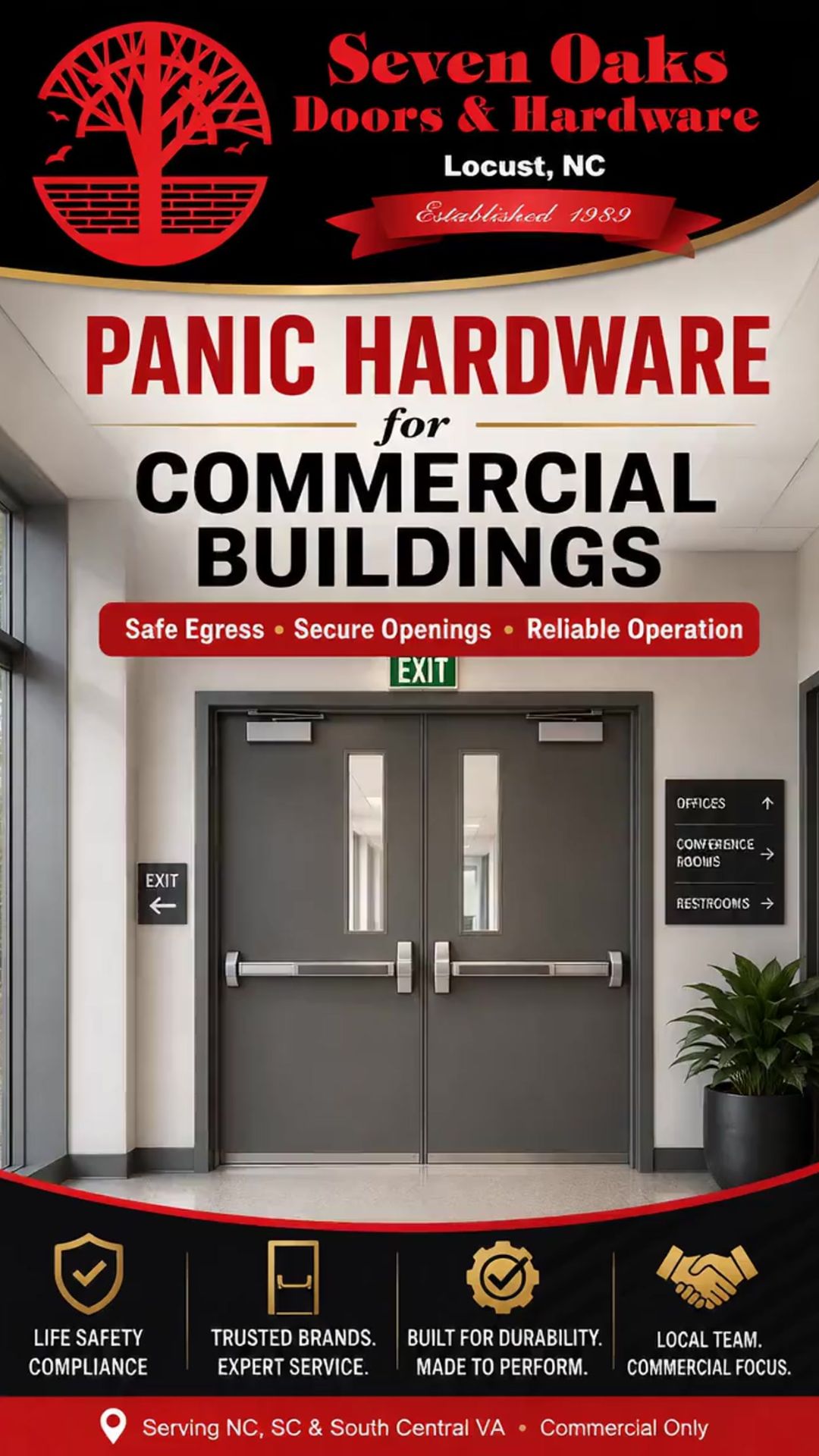
Panic hardware is a type of commercial door hardware designed to release a latched door when pressure is applied to a push bar or touchpad. Instead of requiring someone to turn a knob, operate a lever, or enter a code, the device allows the door to open through a simple pushing motion.
This type of hardware is commonly found on doors serving assembly areas, educational facilities, public buildings, gymnasiums, auditoriums, churches, healthcare properties, and other commercial spaces where safe and efficient egress is important.
The appropriate hardware depends on the occupancy, door construction, opening configuration, fire rating, security needs, and applicable building requirements. Facility managers should have each opening evaluated before replacing or modifying existing hardware.
Panic Hardware and Fire Exit Hardware Are Different
Although the terms are sometimes used interchangeably, standard panic hardware and fire exit hardware are not always the same. Fire exit hardware is designed for use on certain fire-rated openings and must maintain the positive-latching function required for the opening.
Fire exit hardware generally should not include mechanical features that allow the latch to remain retracted. A fire-rated door must be able to close and latch when needed. Hardware that is appropriate for a non-rated exterior door may not be appropriate for a fire-rated corridor, stairwell, or separation door.
Facilities with rated openings should review the complete fire door hardware requirements for commercial facilities before selecting replacement exit devices.
Common Types of Commercial Exit Devices
Several exit-device configurations are available for commercial doors. Rim exit devices are mounted on the surface of the door and latch at the edge of the opening. Mortise exit devices operate with a mortise lock installed within the door. Vertical-rod devices secure the door at the top, bottom, or both locations.
The best configuration depends on whether the opening has a single door or a pair of doors, the door and frame materials, traffic volume, required security, and the condition of the existing opening.
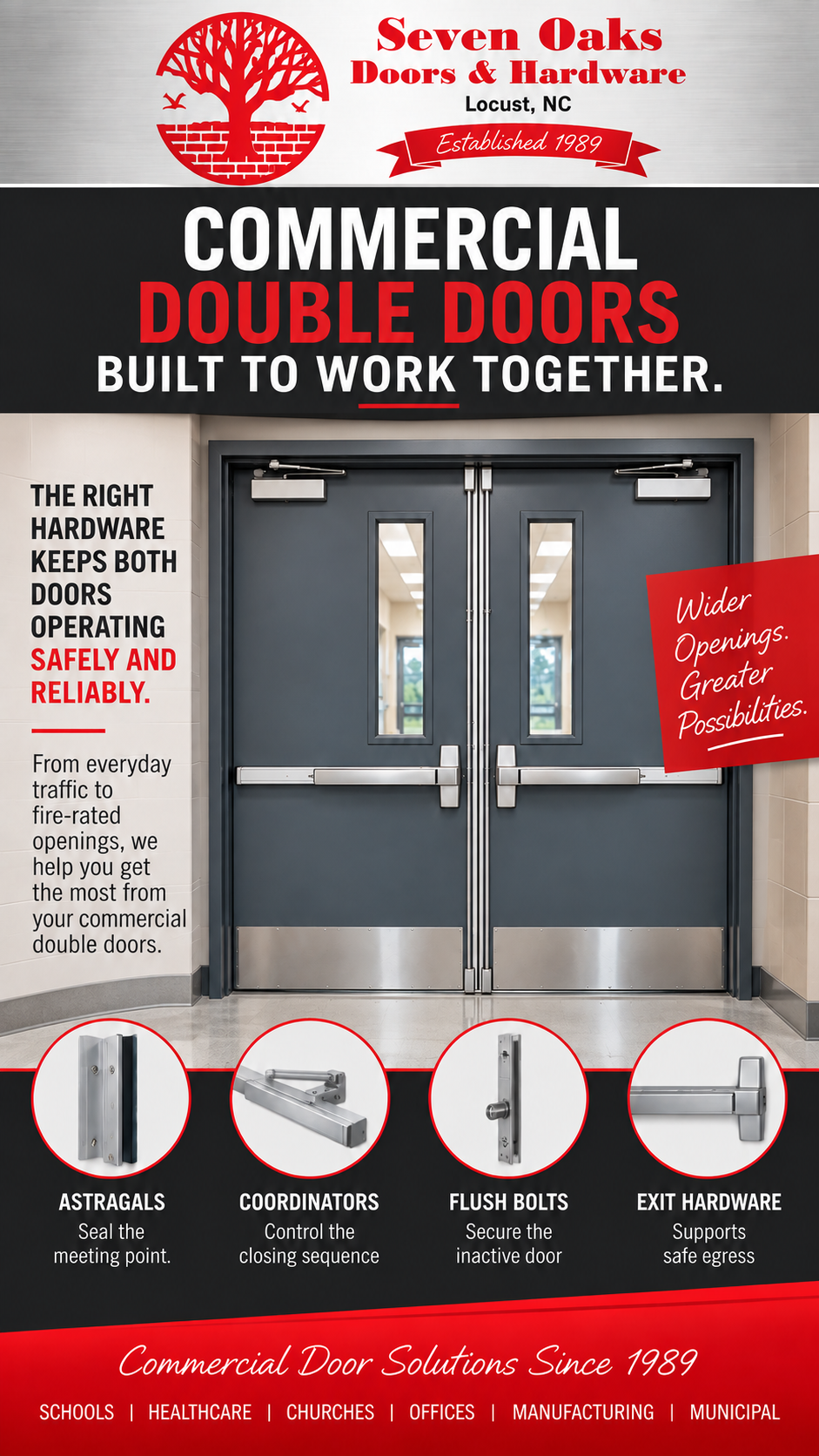
Existing doors may also contain concealed hardware, coordinators, removable mullions, electrified components, or specialized locking arrangements. Replacing one component without considering the rest of the assembly can create operational or safety problems.
Exit Devices Must Work with the Entire Opening
Reliable panic hardware for commercial buildings depends on more than the push bar itself. Hinges, pivots, strikes, door closers, frames, thresholds, weather seals, and locking components all affect how the door operates.
A door may become difficult to open when hinges are worn, the frame has shifted, the device is damaged, or the door drags against the threshold. A closer that is improperly adjusted may prevent the door from opening comfortably or cause it to slam when released.
Seven Oaks evaluates complete commercial door and frame systems so that hardware recommendations address the actual condition and use of the opening.
Combining Exit Devices with Electronic Access
Many facilities need exterior doors that provide controlled entry while preserving free egress from inside the building. Electrified exit devices, electric latch retraction, request-to-exit features, card readers, and other access-control components can help meet these operational needs.
Careful planning is important because the exit device, power supply, access-control system, door position switches, alarms, and related components must work together. The system should support security without making emergency exit unnecessarily complicated.
Organizations upgrading building security can explore electronic access for commercial doors and hardware as part of a coordinated door and hardware plan.
Accessibility Must Also Be Considered
Commercial exit doors should be usable by people with a wide range of physical abilities. The location of the operating hardware, the amount of force needed to open the door, the door closer adjustment, the clear opening, and the surrounding maneuvering space may all affect accessibility.
A heavy door, damaged exit device, or aggressive closer can create an unnecessary barrier even when the opening technically contains the correct type of hardware. Facilities should evaluate ADA door hardware for commercial buildings when repairing or upgrading exit doors.
Warning Signs That Exit Hardware Needs Attention
Facility teams should watch for push bars that stick, loose device covers, damaged end caps, unreliable latching, excessive opening force, doors that slam, alarms that fail to operate properly, or hardware that has been altered to keep the door unlocked.
Doors that are chained, blocked, propped open, or difficult to operate should receive prompt attention. These conditions may indicate a hardware problem, an alignment issue, an operational concern, or an opening that no longer meets the facility’s needs.
Depending on the condition of the opening, commercial door and hardware retrofitting may allow the facility to improve operation, security, and egress without replacing every usable component.
Schedule a Commercial Exit Door Evaluation
Selecting panic hardware for commercial buildings requires an understanding of the door, frame, hardware, occupancy, fire rating, security needs, and daily use of the opening. Seven Oaks Commercial Doors and Hardware can evaluate existing exit doors and recommend practical repair, retrofit, or replacement options.
We work exclusively with commercial facilities and contractors throughout North Carolina, South Carolina, and South Central Virginia. Our team can assist with exit devices, fire exit hardware, door closers, locks, frames, electronic access components, and complete commercial openings.
If your facility has aging, damaged, or unreliable exit doors, request a commercial door and hardware quote from Seven Oaks Commercial Doors and Hardware.