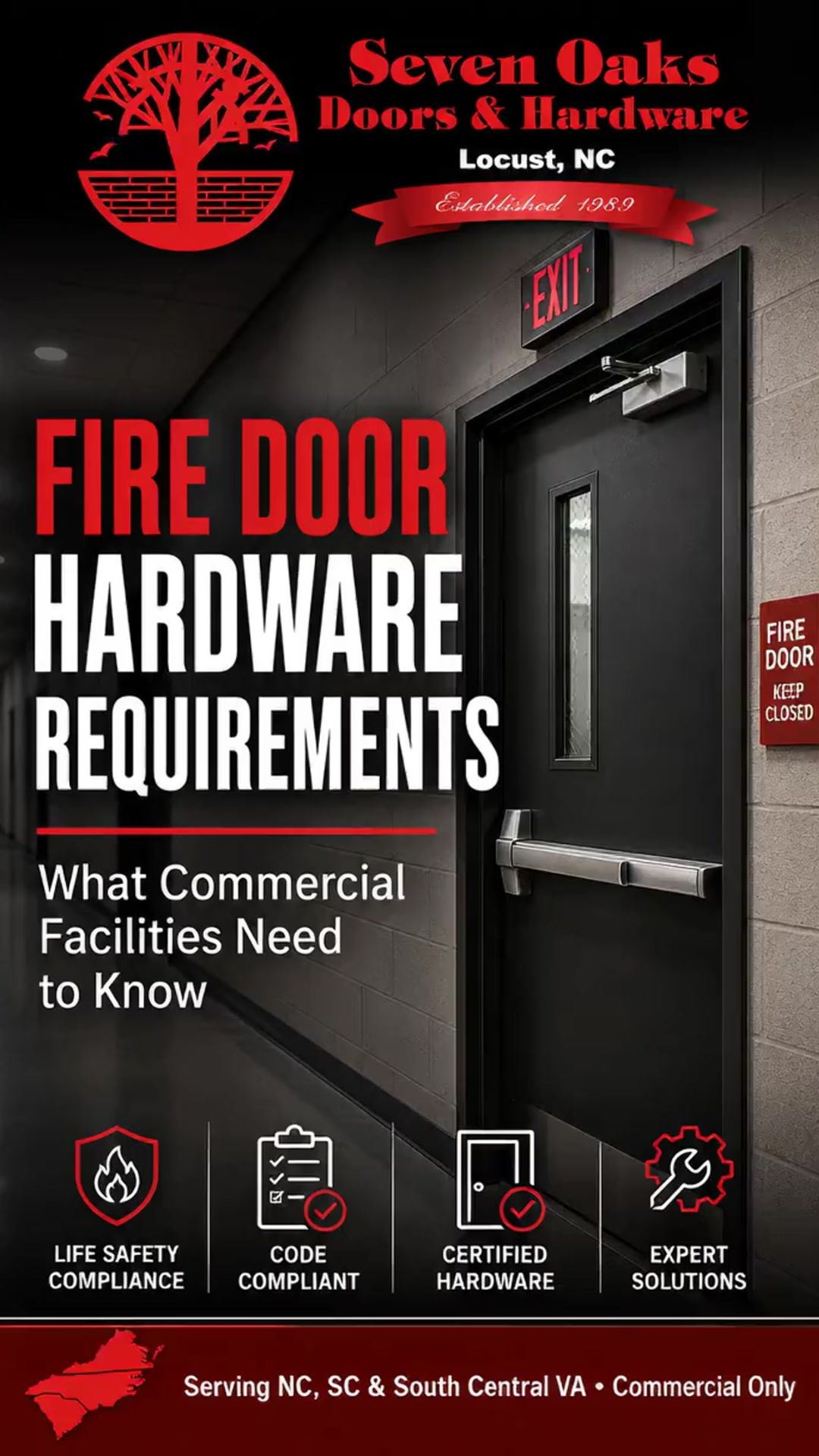
Fire-rated doors play an important role in protecting commercial buildings, their occupants, and surrounding areas. However, a fire-rated door can only perform properly when the frame, hardware, installation, and surrounding opening work together as a complete system. Understanding basic fire door hardware requirements can help facility managers identify problems before they affect safety, code compliance, or the operation of the building.
Seven Oaks Commercial Doors and Hardware helps schools, healthcare facilities, churches, municipal buildings, offices, industrial properties, and other commercial organizations evaluate and upgrade fire doors and hardware throughout North Carolina, South Carolina, and South Central Virginia.
Fire Doors Must Positively Latch
One of the most important fire door hardware requirements is positive latching. When a fire door closes, the latch must engage and hold the door securely in the closed position. A door that rests against the frame without latching may not provide the intended protection during a fire.
Worn locks, damaged latch bolts, loose hardware, misaligned strikes, and improperly adjusted doors can prevent positive latching. Facility teams should not assume that a door is operating correctly simply because it appears to close. The latch must fully engage without requiring excessive force or manual assistance.
Door Closers Must Operate Correctly
Many fire-rated doors are required to be self-closing. The closer must move the door from the open position to the fully closed and latched position. A closer that shuts too slowly, slams the door, stops before latching, or has been disconnected should be evaluated.
Closer performance can also be affected by hinge wear, frame movement, air pressure, damaged seals, or changes made to the opening. Adjusting one component without considering the entire assembly may not correct the underlying problem.
Exit Devices and Fire Exit Hardware
Some commercial openings require panic or exit devices because of the building’s occupancy and egress needs. When an exit device is installed on a fire-rated opening, the hardware must be appropriate for that application.
Fire exit hardware is designed to support emergency egress while maintaining the latching function required for the rated opening. Standard panic hardware and fire exit hardware are not always interchangeable. Facility managers should work with experienced commercial door professionals when replacing or modifying exit devices on fire doors.
Compatible Hinges, Locks, and Accessories Matter
Fire door hardware requirements extend beyond locks and closers. Hinges, pivots, strikes, coordinators, flush bolts, protection plates, seals, and other accessories may all affect the assembly’s operation.
Missing fasteners, field modifications, damaged components, or incompatible replacement hardware can create problems. Drilling, cutting, or altering a rated door without understanding the opening’s requirements may also affect its performance. This is why professional evaluation is important before replacing individual components.
Facilities with older openings may benefit from commercial door and hardware retrofitting. A properly planned retrofit can improve the operation of the opening while preserving usable doors and frames when appropriate.
Fire Doors Should Not Be Propped Open
A fire door cannot provide its intended protection when it is held open with a wedge, chair, kick-down stop, or another unapproved object. If an operational need requires a fire door to remain open, the facility may need an approved hold-open system designed to release the door when the fire alarm or detection system is activated.
Repeatedly finding doors propped open may indicate a larger issue. The door may be difficult to operate, closing too aggressively, interfering with traffic flow, or creating an accessibility concern. These problems should be addressed rather than bypassing the door’s protective function.
Accessibility and Fire Safety Must Work Together
Commercial doors must often support several requirements at the same time. A fire-rated opening may also need to provide accessible operation, secure entry, and safe emergency egress. Hardware should not solve one problem while creating another.
Facility managers evaluating door operation should also review ADA door hardware for commercial buildings. Opening force, closing speed, reachable hardware, and ease of operation should be considered alongside the fire-rating and latching requirements.
Common Warning Signs in Existing Facilities
Facility teams should pay attention to doors that fail to latch, drag against the frame, have loose hinges, contain damaged exit devices, close unpredictably, or show evidence of unapproved modifications. Missing labels, holes in the door or frame, broken glass components, and damaged seals may also require professional attention.
In some cases, hardware repair or adjustment may restore proper operation. In others, extensive damage or incompatible modifications may mean that fire-rated commercial door replacement is the more dependable long-term solution.
Schedule a Professional Commercial Door Evaluation
Fire doors should be evaluated as complete openings rather than as separate pieces of hardware. Seven Oaks Commercial Doors and Hardware can assess existing doors, frames, locks, closers, exit devices, and related components and recommend practical repair, retrofit, or replacement options.
If your facility has aging, damaged, or unreliable fire door hardware, request a commercial door and hardware quote from Seven Oaks. We serve commercial facilities throughout North Carolina, South Carolina, and South Central Virginia.