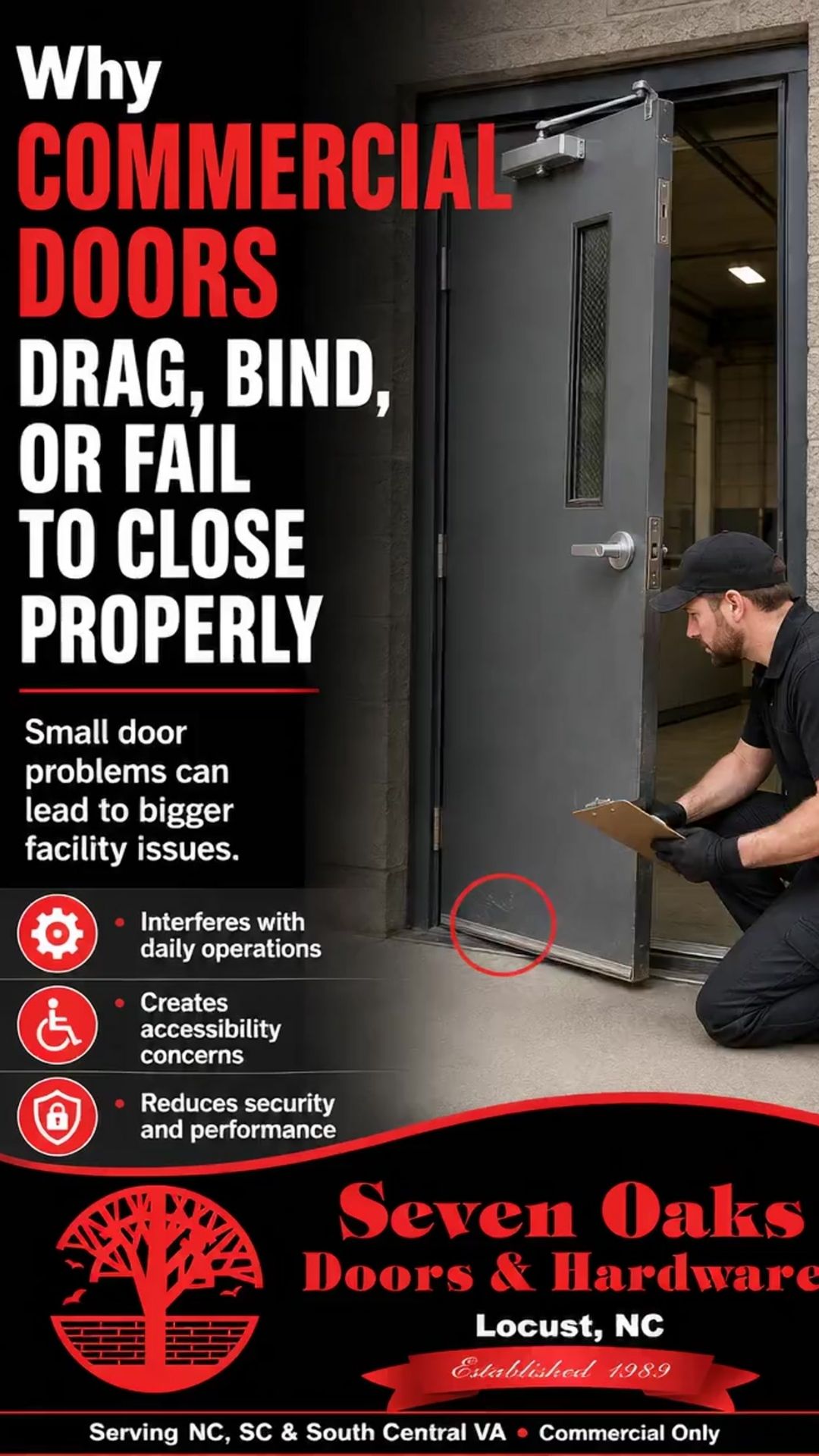
A commercial door that drags across the floor, catches against the frame, or refuses to close completely can quickly become more than a minor inconvenience. Door alignment problems can interfere with daily operations, create accessibility concerns, damage surrounding hardware, reduce security, and prevent fire-rated openings from performing as intended.
Schools, medical offices, churches, industrial facilities, municipal buildings, retail properties, and other commercial locations depend on doors that open, close, latch, and lock reliably. When a door begins sticking or binding, identifying the cause early may help prevent additional damage and more expensive repairs.
Why Commercial Doors Begin Dragging or Binding
Commercial doors are used repeatedly throughout the day. Over time, the weight of the door, frequent traffic, impact, weather exposure, building movement, and worn components can affect its position within the opening.
One common cause is worn or damaged hinges. Hinges support the full weight of the door. When screws loosen, hinge leaves become bent, or internal hinge components wear down, the door may begin to sag. A sagging door often rubs against the threshold, floor, or upper corner of the frame.
The door frame itself can also become damaged or misaligned. Frames may shift because of building settlement, moisture, impact from carts or equipment, or deterioration around the wall opening. Even a small change in alignment can prevent a commercial door from closing smoothly.
Facilities experiencing recurring alignment problems may benefit from professional commercial door and hardware retrofitting rather than repeated temporary adjustments.
Door Closer Problems Can Prevent Proper Closing
A commercial door closer controls how quickly and firmly a door returns to the closed position. When the closer is improperly adjusted, leaking fluid, worn out, or incorrectly sized for the door, the door may close too slowly, slam shut, stop before reaching the frame, or fail to latch.
Weather conditions and pressure differences inside a building may also affect closer performance. Exterior doors can be especially difficult to control when wind, air-conditioning pressure, or building ventilation pushes against the door.
Replacing or adjusting a closer should include an evaluation of the entire opening. Increasing the closing force without addressing binding hinges or frame alignment can place additional stress on the door and hardware.
Latch, Lock, and Strike Alignment Problems
A door may appear to close but still fail to latch securely. This often happens when the latch and strike plate are no longer properly aligned. The problem may be caused by a sagging door, loose hardware, frame movement, or an incorrectly positioned strike.
For exterior doors, classrooms, offices, storage areas, and other secured openings, a door that does not latch can leave the building vulnerable. Seven Oaks works with products from major commercial lock and hardware manufacturers to help facilities maintain reliable locking and latching performance.
Flooring and Threshold Changes
New flooring, entrance mats, thresholds, weatherstripping, and door sweeps can also cause a door to drag. A replacement floor surface may be slightly higher than the previous material, reducing the clearance beneath the door.
Simply cutting down the bottom of a commercial door is not always the right solution. Fire labels, door construction, required clearances, weather protection, and accessibility should all be considered before altering the door.
Why Properly Closing Doors Matter
A commercial door that fails to close properly may affect security, energy efficiency, accessibility, noise control, and traffic flow. At fire-rated openings, the door must be able to close and latch so the assembly can help limit the movement of smoke and fire.
Facilities should also pay close attention to openings that include fire doors and commercial fire-rated hardware, panic devices, electronic access components, or automatic operators. These systems depend on correct door alignment and compatible hardware.
Commercial Door Evaluation and Replacement
Some dragging and closing problems can be corrected through hardware adjustment or replacement. Other openings may require new hinges, a door closer, lock hardware, frame repair, or a complete door and frame replacement.
Seven Oaks Commercial Doors and Hardware provides commercial doors and hardware services for existing commercial buildings throughout North Carolina, South Carolina, and South Central Virginia. The team evaluates the complete opening and recommends solutions based on the door, frame, hardware, building use, and performance requirements.
Commercial facilities experiencing doors that drag, bind, slam, stick, or fail to latch can request a commercial door and hardware quote from Seven Oaks.